When the Wild Walks the Roads: Nature’s Unspoken Cry for Space
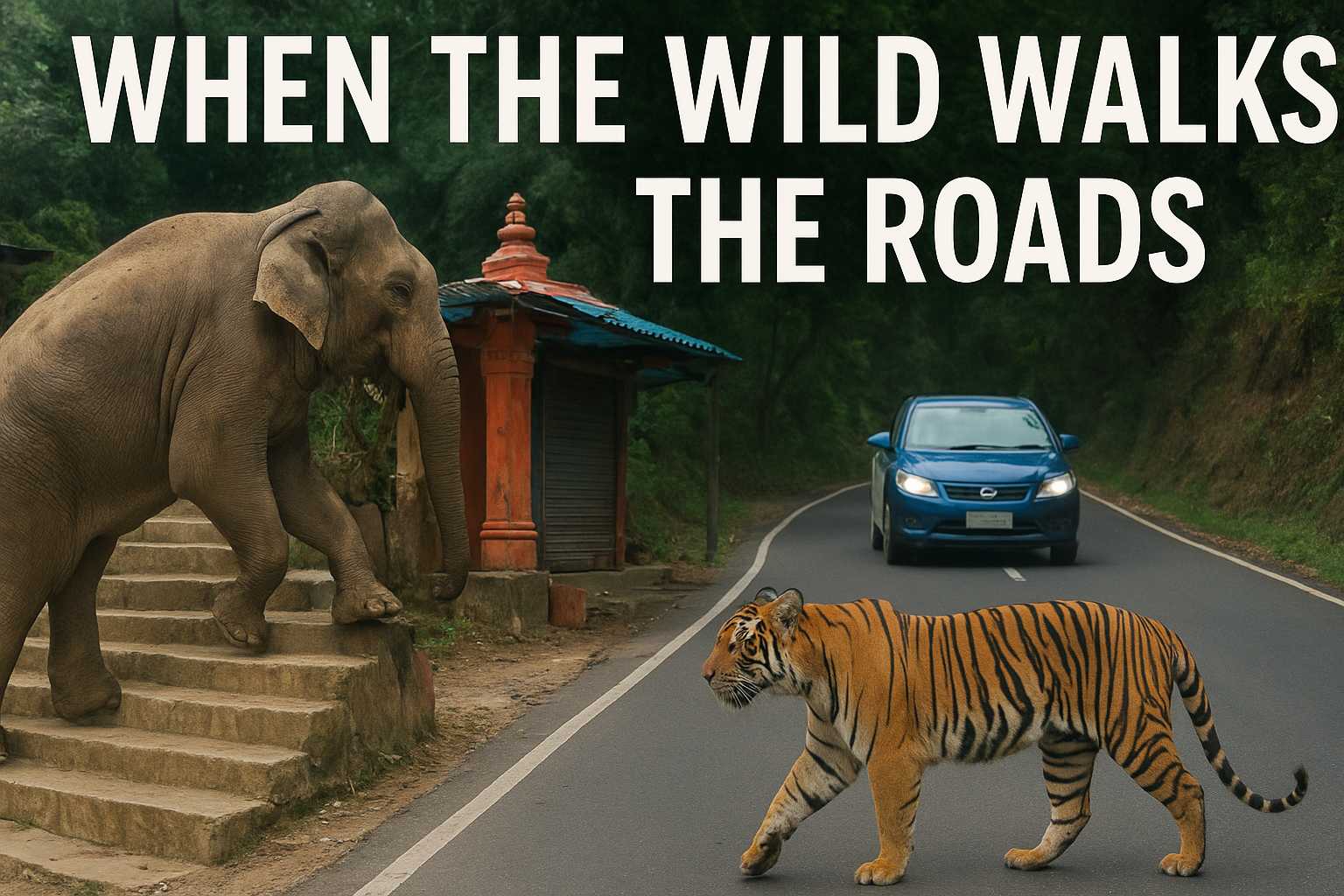
It started on a grainy CCTV feed: just after 2 a.m., a lone elephant, huge, quiet, and impossibly steady, picked its way up about 40 stone steps to the Garjiya Devi temple complex in Ramnagar. The camera shows the animal pausing, sniffing at the broken stalls and plastic tarpaulins, then moving on as if searching for something it could no longer find in the shrinking forest. The footage has been shared and reshared, and the video is now viral on social media.
The temple, surrounded by dense forest and elephant corridors, has always coexisted with the wild. But this? This was nature crossing a line, not in anger, but in quiet desperation. The elephant had followed the scent of prasad and the faint sweetness of bananas offered to the deity. What should have been a divine morning turned into a spectacle that left everyone breathless and uneasy.
As forest rangers gently guided the elephant back into the woods, one couldn’t help but wonder: What’s happening to the balance between man and beast?
There was a time when the line between forest and human world was thinner, when wild calls echoed through the night and villagers knew better than to step out after dark. Old stories from the hills still whisper about tigers that once prowled the outskirts, sometimes taking livestock, sometimes even children. But for years, those tales had become just that, stories, softened by time and distance. The forests grew quieter, and people believed coexistence had been achieved. Yet, nature never forgets its rhythms. As deforestation and human encroachment continue, the game of survival has begun anew. The wild is not retaliating, it’s reclaiming. And in this renewed encounter, both humans and animals are being forced to learn the rules all over again.
Tigers on the Trails of Tourists
Just a few hours away, around Nainital and Almora, the roads that once echoed with the laughter of tourists now carry whispers of awe and fear. Drivers returning from Bhimtal or Sattal occasionally stop dead in their tracks—not because of traffic, but because a Royal Bengal tiger has decided to stroll across the road.
Dashcam videos show the majestic cat, muscles rippling under golden fur, padding across the asphalt under a pale moonlight. In Almora, a tiger was even spotted near Jageshwar Dham, its stripes glowing faintly under the headlights before it disappeared into the shadows.
Locals aren’t shocked anymore; they’re learning to live with it. “We built roads through their homes,” one driver says. “Now they’re just reclaiming what was always theirs.”
When Roads Become Battlefields
Not all encounters end peacefully. In Chittoor district, Andhra Pradesh, a truck once struck a herd of young elephants crossing the highway. Three calves died instantly, a gut-wrenching sight for rescuers and locals who gathered helplessly on the roadside.
In Odisha, another lone elephant began stopping cars, inspecting them for food. Passengers sat frozen, afraid to breathe. And on the Dehradun–Haridwar highway, a wild tusker charged at a car near a toll plaza, smashing its windshield before vanishing into the night.
Every incident tells a story, a reminder that wildlife corridors and human ambition often collide head-on.
The Global Road to Nowhere
These stories aren’t limited to India. Across the world, animals are stepping onto asphalt paths laid through what used to be their wilderness.
Russia: The Silent Death of the Amur Tiger
In the frozen forests of the Russian Far East, Amur tigers, majestic, rare, and regal, are falling victim to roads and rail lines. Since 1980, 26 tigers have been hit by vehicles, with nearly half of those deaths occurring in just the last few years. Most incidents happen in the darkness of January, when snow muffles sound and headlights blur in the white void.
Malaysia: The Baby Who Never Made It Home
On Malaysia’s East–West Highway, a five-year-old elephant calf was hit by a truck. The mother stood by the road, nudging the lifeless body with her trunk, unwilling to leave. The image of maternal grief under harsh highway lights—haunted the nation. Rangers had to tranquilize her to prevent her from charging vehicles.
In another Malaysian story, a Malayan tiger crossed a busy road in daylight, startling motorists. Dashcams caught the moment, a flash of orange and black in the middle of the highway, a brief reminder that even predators have nowhere left to go.
Zimbabwe: Tragedy Near Victoria Falls
On a road near Kazungula, a car overtaking another struck a young elephant. The impact was so strong that the elephant landed on the vehicle’s roof. One passenger died instantly; others were badly injured. Rangers were forced to put down the elephant. What was once a road through paradise had become a corridor of loss.
United States: Bears on the Freeway
In California, a bewildered black bear wandered onto a busy freeway, freezing traffic as drivers stared in disbelief. Days later, another bear in Sonoma County was struck by a truck, its 430-pound body tumbling onto the shoulder as airbags burst inside the vehicle.
Wildlife officials say such incidents are rising, with over 1.7 million animal collisions reported annually in the U.S., mostly with deer.
A Global Phenomenon: When Nature Pushes Back
What’s happening in Uttarakhand is not unique. Across the world, animals are making appearances in places we once called exclusively human.
-
In Italy, during the 2020 lockdown, deer and wild boars were seen wandering through empty city streets and village squares. Locals watched in awe as nature seemed to reclaim its silence.
-
In Japan, sika deer from Nara Park began roaming the nearby city areas in search of food when tourism halted, reminding people how dependent some wild creatures had become on human activity.
-
In Chile, a wild puma was spotted wandering through the capital, Santiago, leading to temporary lockdowns for safety. Experts said the animal had ventured out because construction and noise had pushed it away from its natural range.
-
In India’s Ooty, bison are a regular sight on hill roads now, casually crossing lanes or grazing on roadside grass. Drivers often stop to let them pass, a silent understanding between man and beast.
-
In California, mountain lions have been captured on doorbell cameras, prowling suburban neighborhoods after dark. As housing expands into hillside terrain, these encounters are becoming startlingly frequent.
A Personal Encounter in Canada
Here in Canada, I’ve seen it too. In my own neighborhood, once surrounded by open fields, coyotes and even wolves now appear near homes. Construction has transformed vast green spaces into concrete landscapes. The wildlife that once thrived there hasn’t vanished; it’s simply adapting, searching for food and space where it can.
At first, it felt eerie, seeing glowing eyes by the roadside at night. But over time, it became clear: they weren’t invading our world. We were expanding into theirs.
What the Wild Is Telling Us
Each of these moments, from the elephant in Ramnagar to the tiger in Terengganu, feels like nature whispering, “I’m still here.”
These animals aren’t invading our spaces; they’re navigating through what used to be theirs. Highways cut across ancient migration routes. Cities expand into forests. Food waste piles up near temples and resorts, luring wildlife closer. In return, the wild responds the only way it knows, by walking the same paths it always has.
Perhaps the most haunting part of these encounters isn’t the danger, but the reflection they offer:
We marvel, we record, we post, but do we listen?
If the elephant climbing Garjiya Devi’s steps could speak, maybe it would ask us to slow down, to respect the borders we’ve erased. Maybe it would remind us that coexistence isn’t just about admiring wildlife from a distance, it’s about protecting the invisible bridges that connect our worlds.
Why animals are on our roads and in our towns, the reasoning, plain and simple
-
Old corridors, new asphalt. Roads and development often cut through ancient migration routes. An animal following its ancestral path can suddenly find itself on pavement. Studies of Amur tigers and other species show roads increase mortality and fragment habitat, a literal severing of safe passage.
-
Food and temptation. Temples, roadside stalls, unsecured trash, and even spilled crops act as magnets. An elephant following the scent of food or a coyote attracted to rodents near construction sites is following sensory logic we can all understand. (Local reports around temple incidents and park edges often mention food smells and garbage as contributing factors.)
-
Habitat loss and urban sprawl. When fields become houses or highways slice forests, animals are forced into narrower spaces. That’s precisely why adaptable species (coyotes, foxes) move into towns and why wide-ranging species (elephants, tigers) sometimes show up in human areas.
-
Nighttime danger & speed. Many collisions happen at night or in low visibility. In the U.S., insurers reported about 1.7 million animal-collision claims over a recent 12-month period — mostly deer, often concentrated in autumn months when animals are more active. That shows how commonly wildlife-vehicle interactions happen even in highly motorized countries.
-
Climate, seasons, and prey shifts. Changes in prey distribution, weather extremes, or disease (which can reduce prey numbers) can push predators to search in unusual places, even along roads that paradoxically offer easier movement. Research in Russia’s Far East shows traffic and seasonal conditions combine to spike Amur tiger collisions.
What we can do (real actions, not platitudes)
-
Respect wildlife corridors when building: corridors and underpasses reduce collisions; some regions are already adding them where accidents have occurred. The Malaysian wildlife department and other agencies have begun investing in crossings and signage for known hotspots.
-
Slow down, especially after dusk: fewer collisions happen where speed limits are enforced and lighting is appropriate. In known wildlife zones, lower speeds give drivers time to stop.
-
Secure waste and remove attractants: at temples, picnic spots, construction sites, and resorts — keep food sealed and trash away from forest edges.
-
Education & rapid response: local forest departments, patrols, and community reporting (camera traps, CCTV) help track patterns and move animals safely away from danger. The very CCTV video that made the Garjiya elephant famous showed officials where the animal moved and helped avoid human injury.
-
Design roads with wildlife in mind: overpasses, underpasses, fencing at strategic points, and signage for drivers — these practical responses reduce death, injury, and trauma.
The Road Ahead
The path to peace between man and beast lies in awareness and action, from better signage and wildlife crossings to responsible tourism and strict speed limits in forest zones.
Because every time an elephant walks up temple stairs or a tiger appears on a road, it isn’t just a viral moment—
It’s a message.
And the question remains: Are we willing to listen?