Spirituality and Joy: A Journey to New Vrindaban, West Virginia
The priest’s voice echoed in the quiet hall: “Why do we work countless hours in our lives? Why do we build a house? Why do we buy a car? Why do we travel?” Around me, people whispered their own answers, but his reply was disarmingly simple: “To find joy.” That single word hung in the air, stirring something deep within me. We spend our lives chasing goals, believing happiness lies in the next achievement, only to find that joy slips away as quickly as it comes, pushing us into yet another pursuit.
Prabhupada, the revered spiritual teacher and founder of ISKCON, recognized that joy seemed absent in people’s lives. Whether rich or poor, everyone carried their own burdens of unhappiness. To offer a path back to inner peace, he introduced the Mahamantra: “Hare Krishna, Hare Krishna, Krishna Krishna, Hare Hare. Hare Rama, Hare Rama, Rama Rama, Hare Hare.” In these sacred words, the name of God is repeated sixteen times. When chanted 108 times, the full cycle of a bead necklace, a devotee calls upon God’s name 1,728 times. Prabhupada believed that those who embraced this practice daily would discover a deeper, lasting happiness, unlike the fleeting pleasures of worldly pursuits.
My mother-in-law was a devoted follower of Lord Krishna, her lips constantly moving in His name throughout the day. In her devotion, she had found a calmness and peace that many of us spend a lifetime searching for. We once promised her that we would take her to visit ISKCON temples across the world, fulfilling her dream of experiencing Krishna’s presence in every corner. When she visited us in Canada, we took her to the ISKCON temple in Toronto during the vibrant Janmashtami celebrations. I still remember the way her face lit up; she was exhilarated, almost childlike in her joy, completely immersed in the divine atmosphere.

Later, during a family road trip to the United States, I discovered that there was an ISKCON temple in West Virginia, just a short detour of about 100 kilometers from our route. Excited, I asked my husband if we could visit with her, and he happily agreed. Nestled on top of a hill, the temple stood serene and majestic, surrounded by nature’s stillness. My mother-in-law’s joy that day was beyond words, her eyes sparkling with the same devotion that had carried her all her life. It was 2017, and though we could only spend a few hours there, the experience etched itself in our memories. Only later did we realize that visitors could stay overnight within the temple complex, something we promised ourselves to do next time.
Years later, in 2024, when our friends visited us from Dubai, we decided to return to New Vrindaban. This time, we made sure to book two rooms so we could finally stay overnight within the temple complex. The experience was nothing short of beautiful. Surrounded by the peaceful rhythm of prayers and the gentle sounds of nature, we felt transported into another world. Colorful peacocks roamed freely around the grounds, their presence adding a magical charm to the serene atmosphere.


When I shared our experience with friends in Canada, they too became eager to visit. So, this summer, we planned another trip to New Vrindaban together. We booked two ground-level rooms with attached bathrooms, located in an apartment building just a short walk from the temple. Staying on-site allowed us to fully immerse ourselves in the spiritual rhythm of the place. A Govinda’s Express restaurant within the complex served wholesome Saatvik meals; vegetarian food prepared without onion, garlic, or meat — simple yet deeply nourishing. The temple followed a beautiful daily schedule of aartis, chanting, and meditation. We joined a guided tour through the lush vegetable gardens, the cow farm, the Golden Palace, and the historic Old Vrindaban site. Everywhere we turned, the surroundings were alive with nature: peacocks spreading their feathers, deer grazing gracefully, swans gliding over the water, and countless other wild animals, making the experience feel truly magical.
Our journey to New Vrindaban began bright and early at 5 a.m., as we prefer to start early to avoid heavy morning traffic and border delays. The drive was long, approximately five and a half hours, but starting early made it peaceful and manageable. By 6:40 a.m., we had already crossed into Buffalo, United States, and stopped for a quick breakfast at Tim Hortons around 8 a.m. I was surprised to see so many Tim's outlets along the way; the last time I had been in Buffalo, there was only one! Later, around 10:30 a.m., we made a brief detour to the Grove City Mall in Pittsburgh at my friend’s request. We shopped for a little while, enjoying the lively atmosphere, before resuming our journey toward the serene hills of New Vrindaban.
As lunchtime approached, we hunted for an Indian restaurant in the city and eventually stopped at Mintt Indian Cuisine in Pittsburgh. At first, the restaurant didn’t give off the best vibe; the seating felt a bit ordinary, and the décor was unremarkable. But once the food arrived, all doubts vanished. We had ordered a South Indian meal, and to our delight, it was absolutely delicious. The dosas were crisp, the sambhar perfectly spiced, and the chutneys flavorful. The service was impressively fast, and when we requested extra chutneys and sambhar, the staff happily obliged, adding to the warm, satisfying experience of our lunch stop.
After lunch, the drive from the restaurant to the temple took about an hour and a half. The last 20 minutes, climbing toward the mountain, were quite challenging. The roads became narrow and winding, with sharp turns that kept our hearts racing. Large trucks occasionally passed by on these small roads, making the drive even more intense. It was a reminder to stay vigilant and take it slow; patience and careful driving are essential on this stretch. Despite the thrill (and a bit of fear), the anticipation of reaching the serene temple at the top made every moment worthwhile.
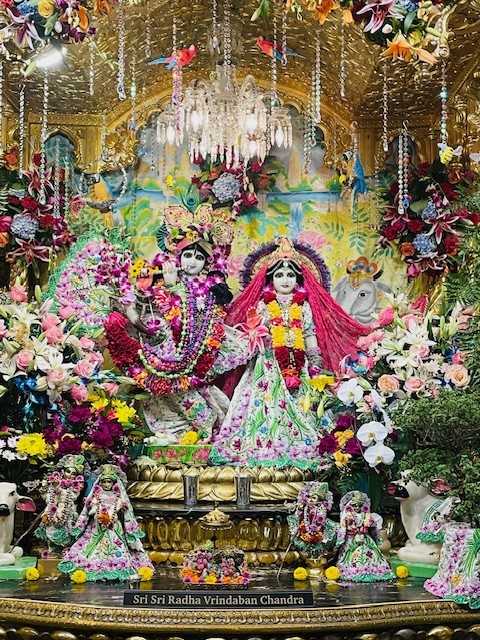
We reached the temple at 2:30 p.m., a little earlier than the official check-in time of 4 p.m. The office kindly handed us the keys for one room right away, and the second room was ready an hour later. In the meantime, we enjoyed masala chai and some delicious laddoos at Govinda’s Express and rested briefly in the room. Soon after, we changed into our traditional Indian attire, feeling a mix of excitement and reverence. I was especially thrilled to meet Krishna, and stepping into the temple courtyard, the energy and devotion around us made my heart race with anticipation.
After spending some time inside the temple, we ventured out to explore the surrounding area. It was late August, and the sun made the hilltop feel quite hot, but the beauty of the place made the heat worthwhile. While walking, we noticed two boys carrying peacock feathers and learned that peacocks naturally shed their feathers around this time of year. Excited, we kept our eyes open and were delighted when our friend spotted a few feathers for us to take home. Peacocks hold a special significance in Krishna’s lore, and I placed the feathers in my temple back home as a cherished memento.
Along with the peacocks, we encountered a variety of wildlife: deer gracefully grazing, beavers near the streams, swans gliding over the water, and even a rare white peacock strutting majestically. As evening approached, the 7 p.m. aarti was ecstatic; the temple resonated with the sound of devotees chanting Krishna’s name, and everyone joined in dancing with joy. It was heartwarming to see many White Americans actively participating in the worship, serving the deity with devotion. After the aarti, we headed to Govinda’s Express for dinner, where a traditional thali was served: paneer with gravy, dal, rice, poori, and salad. The flavors were simple and comforting, so we finished with chai and samosas to refresh our taste buds and end the day on a flavorful note.
That night, the sky above the temple was phenomenal, a blanket of countless stars stretched across the heavens. As we gazed upward, tiny fireflies flickered around us, adding a magical glow to the serene night. It was a rare moment of stillness and wonder, a perfect pause to soak in the beauty of nature and the peace of the temple surroundings.
I was amazed to see so many people attending the 5 a.m. morning aarti the next day. The last time I had visited at that hour, there were hardly ten people, but this time, nearly everyone staying in the apartment participated. The energy was astounding, filling the temple with a sense of collective devotion and peace. After the aarti, we joined in mantra meditation and chanting back in our rooms. Each of us was given tulsi beads, which we brought home as a cherished reminder of the spiritual experience. For those interested, there’s also an opportunity to volunteer in the kitchen, preparing prasad that is later lovingly distributed among the devotees.

After meditation, we walked toward the Golden Palace, a magnificent black-and-gold structure overlooking the verdant valleys below. As we reached the viewpoint, the sunrise began to unfold, casting soft golden and pink hues across the rolling hills. The light seemed to awaken the valley, making the greenery shimmer with a warm glow. From the nearby water bodies, a gentle mist rose, weaving through the trees and hills like a delicate veil, giving the landscape a mystical, almost otherworldly feel. The combination of light, mist, and the quiet sounds of nature created a serene atmosphere that left us momentarily speechless. West Virginia’s natural beauty, framed by the grandeur of the Golden Palace, was breathtaking. Inside the palace, there’s a small museum with an entry fee of $12, offering insights into the history and cultural significance of the temple, a wonderful addition for those who want to explore further.

On the temple grounds, a lotus pond filled with blooming water lilies added a serene charm to the surroundings. Not far from the Golden Palace lies Old Vrindaban, a peaceful area steeped in history and devotion. We took a leisurely hike along the trails behind the temple, winding past quaint cottages where guests and priests stay. Along the paths, we came across beautifully crafted statues of Gaura Nitai, Lord Krishna’s devotees, Krishna's favourite animal, the cow, and an elephant, each radiating reverence and artistry. Peacocks roamed freely throughout the area, some almost playful, pausing gracefully as if posing for photographs. Walking through these trails, surrounded by nature, devotion, and art, felt like stepping into a world where serenity and joy coexist perfectly.

The ambiance at New Vrindaban is truly special, a place where anyone seeking to connect with their higher self, find inner peace, and experience genuine joy can feel completely at home. Whether you choose to stay for a night, two, or longer, the serenity of the temple grounds, the devotion in the air, and the beauty of nature combine to create an unforgettable experience. We absolutely loved our stay in New Vrindaban, West Virginia, and would wholeheartedly recommend this remarkable place to anyone looking for a spiritual retreat, a nature escape, or simply a journey that nourishes both heart and soul.